
There is a geological formation deep inside the Gouffre de Padirac, 120 metres below the surface of southern France, that looks almost exactly like the pipe organ inside the Cathedral of Rodez. One is hundreds of millions of years old. The other is a few centuries old. Holeg Spies saw them both within days of each other and the coincidence broke something open.
“I will never go to space,” he tells me, sitting in the bookshop during a signing event for his book Echos des Origines (Signal Zéro Editions), “but standing there, 120 metres underground, I experienced something close to weightlessness. A subterranean river, small lakes, concretions shaped over geological time — and then this enormous formation that looked like a cathedral organ. That was the moment. As a composer, I knew I had to work with caves.”


What followed was not a composition but a research process lasting several years. Spies came across a body of acoustic studies conducted in the 1980s inside ornamental caves — the painted caves of the Palaeolithic — that revealed two extraordinary findings. The first was that their original inhabitants possessed an acute enough sense of hearing to navigate dark corridors through echolocation, the same technique used by bats and dolphins, producing small sounds with their mouths and interpreting the returning echoes to orient themselves in complete darkness. The second finding was even more striking: across ornamental caves in Europe, Asia and South America, roughly ninety per cent of the most significant frescoes had been painted on the most acoustically resonant walls.
The caves were not chosen simply as surfaces to paint on. There was a sonic dimension to the act itself — sound accompanied the painting, and the walls were selected for how they reverberated.
In some caves, at Chauvet and Pech-Merle, archaeologists discovered circular footprints left by children and, apparently, women. Not walking in circles. Dancing.
And that, for Spies, was the connection that changed the direction of his thinking. Thirty thousand years later, he had lived something strikingly similar. Holeg Spies was a law student at the Sorbonne in the early 1990s. He wanted to become a diplomat. He also started mixing records in his bedroom, then handing cassettes to people around Radio FG, where Patrick Rognant was becoming the voice of French techno. Spies got booked. A booking agency sent him on tour in India. When he returned and sat back down on the benches of the Panthéon, the question answered itself.
“I realised I could do more about my utopian desire to change the world through music than I could through diplomacy and law,” he says.
Three decades later, the trajectory has circled back. Spies is now preparing to re-enter the Sorbonne as an artist-researcher, potentially pursuing a doctoral project at the École des Arts, working with sociology and anthropology laboratories, as well as a research unit on urban sound environments at the Grenoble school of architecture.
The bridge between these two lives — the DJ and the researcher — is the book itself.

Echos des Origines is subtitled Manifeste pour l’écoute: De l’Art Pariétal à la Rave Techno — Une Expression de l’Ecophonisme. It opens with a chapter on the Hopi people’s relationship to sound and listening, moves through the sonic worlds of Palaeolithic cave art, passes through the history of early techno, and arrives at a new concept that Spies calls Ecophonisme. It includes a preface by Isabelle Warnier Henry, guardian of the estate of the pioneering composer Pierre Henry, and postfaces by an astrophysicist from the CEA, an archaeologist of sonic heritage from the CNRS, and — more unexpectedly — an artificial intelligence.
It is not a scientific work. Spies is clear about that. It is an essay, a speculative investigation, a set of connected intuitions grounded in extensive reading and thirty-five years of immersion — in raves, among indigenous communities, in the Mongolian steppe, underground.
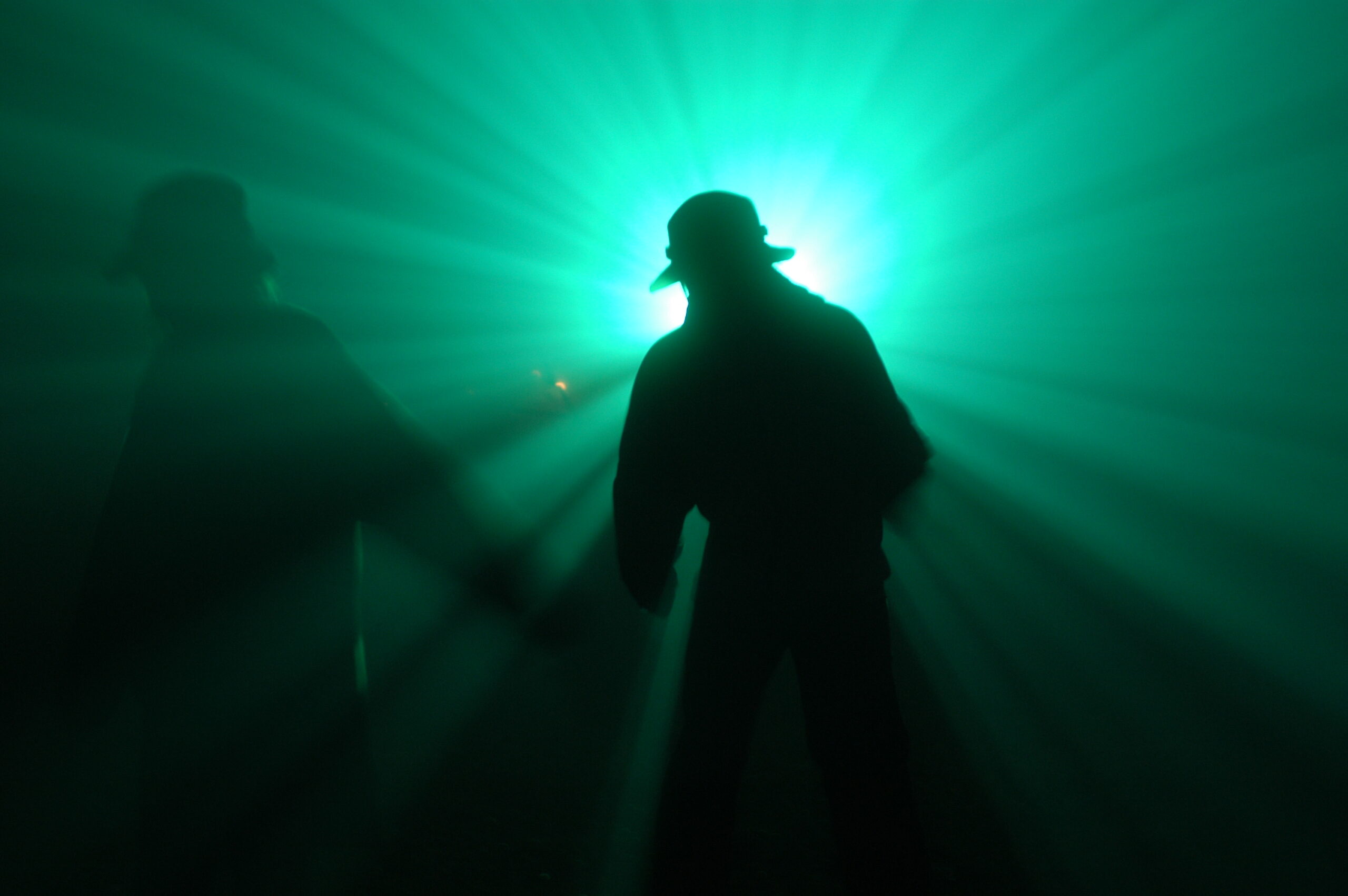
The central argument can be stated simply. Raves and Palaeolithic cave rituals, separated by thirty thousand years, are structurally identical phenomena. Both gather individuals in immersive environments — a cave, an industrial warehouse — around a sonic experience that calls for genuine listening. Both, in the suspended time of a shared celebration, pursue the same objective: making community. Making society.
“It is about individuals assembling in immersive spaces, around a sonic universe that calls for real listening, and together, for the duration of a celebration, pursuing the same goal: making community. It’s as simple as that.”
It is tempting, of course, to push back. The early raves were not exactly community workshops. They were illegal, chaotic, sometimes violent, frequently at war with local authorities. To anyone who lived through the tensions between free party culture and the French state in the 1990s, describing a rave as a ritual of collective belonging might feel like a generous rewriting.
Spies does not deny any of that. But he frames the illegality differently, drawing on the anthropologist Victor Turner’s concept of communitas — the temporary dissolution of individual identity into a shared collective experience, something Turner argued was present in rituals across all human cultures.
“It’s communitas in the sense of forgetting oneself, transcending the individual to join the collective,” Spies explains. “In the 1980s, as the world was becoming increasingly neoliberal, with unemployment rising, industries collapsing, factories closing one after another, I think the rave movement awakened a need — not for revolution, because there was no political agenda — but for a kind of ephemeral utopia. People gathering beyond their social categories, beyond their origins, in dark spaces, around extremely binary music, to forget themselves and create their own society.”
He pauses. “Today, the closest heirs to that are probably the free parties. Not the wider electronic music scene. The free parties still carry that spirit.”
Pierre Henry, the French composer who essentially invented musique concrète in the 1950s, appears throughout the book — indirectly, through the words of his widow Isabelle Warnier Henry, who wrote the preface. The connection might seem contradictory. Henry was famously obsessive about studio control, spending hours calibrating sound engineers. The rave is the opposite: total immersion, physical surrender, acoustic chaos.
But Spies sees a direct lineage. Henry was already thinking about the spatialisation of sound in live performance decades before anyone used the word “immersive.” He wanted to control not just the composition but the way sound moved through space, reaching audiences as a physical experience rather than a passive listening session. And his foundational work — sampling found sounds, treating any source as potential music — laid the conceptual groundwork for everything that electronic music would later become.
“Well before anyone was talking about immersive experiences, in the 1950s, he was already thinking about how to arrange sound systems during performances,” Spies says. “He was torturing sound engineers for hours, because he wanted to create a genuine spatial immersion. Sampling is just the inheritance of that.”
The most vulnerable part of the book — and arguably the most interesting — is where it steps beyond established science. Among his sources, Spies cites neuroscientists and astrophysicists alongside Masaru Emoto, a Japanese researcher whose experiments on water crystals remain deeply controversial in the scientific community. Emoto claimed that the molecular structure of water changed in response to human emotions, words and music. The experiments were never conducted under double-blind conditions and have been widely challenged.
I put the question directly. As a former researcher myself, I wanted to understand how Spies navigated the line between scientific rigour and openness to contested ideas.
“The book is not a scientific work,” he answers immediately. “It’s an essay. I am offering a way of thinking, an idea, an intuition. My goal is to provide pathways for reflection that can open each reader to their own thinking.”
He acknowledges the controversy without retreating from it. “The history of science is also the history of controversy. The fact that these experiments are contested doesn’t mean they are worth nothing. I note in the book that they are controversial. They should be taken for what they are. But they open a door of reflection that I find extremely interesting — especially considering that we are between seventy and eighty per cent water, that we are exposed to a sonic environment from the sixth week of our foetal life until the moment of our death, and that this environment is becoming increasingly cacophonous. What are the effects? That is the question.”
It is a fair position for an essayist. The book does not claim to prove anything. It claims to ask.
The concept that holds everything together is Ecophonisme, a neologism Spies proposes to describe a way of thinking about sonic experience that no single existing discipline adequately captures. Sound ecology addresses environmental sound. Phenomenology addresses perception. Musicology addresses musical form and history. Each, he argues, illuminates a specific dimension, but none of them think together the four elements he considers inseparable: the place, the attention of listening, the body, and the moment.
“Each of these disciplines sheds light on something extremely specific,” Spies explains. “But they don’t develop a genuine interaction with one another. Ecophonisme proposes thinking together the place, the listening attention, the body and the instant — together in a shared experience.”
The practical expression of this concept is where Spies becomes most concrete. He describes his own artistic projects — performances in which the site itself becomes the primary diffuser of sound, with minimal technology, where the audience’s movement through the space creates an individual and unrepeatable sonic experience.
“The best diffuser of sound is the place itself, through its singular acoustics. If we use the site as the essential diffuser, we need minimal technology. And the audience, depending on their position and movement, lives a different sonic experience. That is the future luxury.”
The idea inverts the logic of contemporary concert halls and immersive entertainment, where enormous technological investment aims to make every audience member hear exactly the same thing. Spies wants the opposite: every listener experiencing something different, because each body moves differently through the resonance of a specific place.
One of the book’s most striking claims is that our problem is not noise, but the fact that we have stopped listening. In an age of Spotify playlists and permanent ambient music, the statement feels counterintuitive. There has never been more music available. But Spies draws a sharp distinction between listening, hearing and consuming.
“People hear music, they consume it. Do they truly listen to it? I’m not sure,” he says. He quotes John Cage — if a noise bothers you, listen to it — and argues that the difference between a sound and a noise is entirely subjective. The sound of a waterfall can relax some people and profoundly stress others.
During our conversation, I mention having attended a Mongolian throat singing concert in Paris — an experience that was deeply unsettling to Western ears but clearly a full musical form within its own culture. Spies picks up the thread immediately. “If we reconnected to genuine listening, certain noises might no longer seem like noises. We would start to perceive a musicality in them. And beyond that, reconnecting to true listening would allow us to become conscious of our sonic environment and therefore to take it back into our own hands.”
He frames this as a civilisational issue, explicitly parallel to climate change. “Alongside climate questions — not behind, not ahead, alongside — there are sonic questions that seem to me at least equally important.”
I push further. The philosopher Cynthia Fleury has described silence as a good that is becoming scarce, almost a privilege. If access to silence is a matter of inequality — people with less money live closer to airports, in noisier areas — then the reconquest of listening that Spies proposes is not equally available to everyone.
“Access to silence is clearly a mirror of social inequality,” he responds. “Not a source, but a mirror. People with fewer resources end up living in noisier zones. That should absolutely be addressed at the level of public policy.” But he insists that the starting point, as with climate, is individual awareness becoming collective action. “It’s utopian,” he concedes. “But being utopian doesn’t mean we shouldn’t talk about it.”
Towards the end of the book, Spies proposes something he calls Polyphonie Citoyenne — a performance concept, supported by the Centre National de la Musique, in which citizens would gather inside national parliaments not to debate but to listen to one another.
When I first read it, I took it as a provocation. Spies sees it as a genuine artistic proposal.
“Once a year, the parliaments are opened to citizens, without politicians. There is no rhetoric, no debate. There are moments of listening where each person says what they have to say, tells what they have to tell. And the others are there to listen, in the sense of active listening, as the Buddhists describe it — listening truly, deeply, with empathy.”
The logic is disarmingly simple. Parliaments are supposed to be the places where democratic dialogue happens. They are not, currently, anyone’s model of genuine listening. Spies argues that without listening there is no dialogue, without dialogue no debate, and without debate no democracy. The performance would be a symbolic act of reclaiming those institutions for their original function — but starting from the beginning: listening.
Whether it will ever happen inside an actual parliament is another question. “That’s where it might just remain a horizon,” he admits.
The book closes with a text written by an artificial intelligence. It is a surprising choice for a work entirely dedicated to the human dimension of listening. But Spies’s reasoning is more particular than it first appears. The AI was not asked to write about music, or to generate sound, or to simulate creativity. It was asked a single question: what role could it see itself playing in helping humans reconnect with listening?
“I interrogated eminent human beings throughout the book,” Spies explains. “I start from the Palaeolithic. It seemed interesting, at least I was curious, to ask an AI what role it could play in this challenge of reconnecting with listening. I’ll leave readers to discover its answer.”
The inclusion does not feel gimmicky, because Spies is genuinely uninterested in the debate about AI-generated music that has dominated the cultural conversation around artificial intelligence and sound. He sees AI as continuous with every previous tool — from the MIDI sequencers of the 1990s to digital audio workstations to preset libraries — and less interesting than the question of what happens when human beings stop needing those tools to produce acceptable sound. If machines can handle the production, then what becomes valuable is the thing machines cannot replicate: the lived, embodied experience of shared listening in a specific place, at a specific moment.
“Creating sonic experiences with minimal technology will become the luxury of tomorrow.”
A few days after the interview, I found myself thinking about the concert I had mentioned — the Mongolian throat singing in a small Parisian venue, a sound that my ears initially received as disturbance and gradually learned to accept as music. The shift was not intellectual. It was physical, something the body eventually did on its own, without being asked. Maybe that is the simplest version of what Spies is trying to say: that we carry in us the capacity to listen differently, but we have built a world that makes it almost impossible to remember.
Echos des Origines does not solve that problem. But it asks the right question, and it asks it from an unexpected angle — from 120 metres underground, from a dancefloor at four in the morning, from a Hopi mesa where listening is still considered a sacred act.
Explore More
The following titles offer broader context on the intersections between sound, ritual, underground culture and the body.
-
Holeg Spies – Goa Trance A compact history of Goa trance from one of the first French DJs to tour India in the mid-1990s, published in Signal Zéro Editions’ Sous le Radar collection.
-
L’essentiel de la Goa Trance avec Holeg Spies A long-form video interview with Spies on Histoires Electroniques, covering his trajectory from Parisian law student to Goa trance pioneer.
-
Ecophonisme The official platform for the concept introduced in Echos des Origines, defining Ecophonisme as a way of thinking sound, space, body and attention together.
-
Nasty&Krusty – Loopera A visual and textual document on Italian techno and rave culture, bridging underground sound systems with contemporary art and critical writing.
-
Memorabilia: A Scan Through Dutch Rave Culture Vol. 1 A dense collection of flyers, photographs and ephemera from the Dutch rave scene, designed by Luca Lozano as both archive and object.
-
Club 57 MoMA’s catalogue on Club 57, the East Village venue where performance, film and early electronic music collided between 1978 and 1983.
-
Guillaume Kosmicki – Free Party, une histoire, des histoires A 728-page oral history of the French free party movement — the culture Spies identifies as the closest living heir to the original rave spirit.
-
The Legendary Cave Raves of the Acid House Era Vice’s account of the clandestine raves held inside a remote slate quarry in the Lake District in the late 1980s and early 1990s, where acid house met geological darkness.
-
Rave Culture: From Ancient Rituals to the Modern EDM Scene An essay drawing direct parallels between ancient fire-circle rituals and the contemporary dancefloor as spaces of collective healing and transcendence.
-
Echoes & Paint: Cave Acoustics and Ritual A short documentary examining the archaeological evidence that low-frequency resonance, echoes and reverberation guided where Palaeolithic painters chose to work.