Let’s start from the beginning: WOC, introduce yourself. Where do you come from and how did your path begin?
I come from the graffiti world and, like I believe 99% of writers, I started as a teenager, with my first piece at the skatepark together with a middle school friend.
The initial sparks were twofold: on one side, the attraction to writing on walls, this language that seemed to have its own code and that I wanted to belong to; on the other, a broader passion for art, painting, and more “classical” visual languages.
Over time, I tried to bring these two dimensions together. Thanks also to my studies — art high school and academy — I was able to develop them in parallel, until they met within a single language.
Today my work is mainly focused on spray paint, which remains my primary medium: an immediate, direct approach that I bring into a practice that is also conceptually constructed.

Before going into detail, can you tell us about the Postcard Lottery project?
The project was born last year from the idea of working with mail art, therefore with the act of sending an image. I was interested in transforming this gesture into something broader: not just sending a postcard, but building an experience linked to travel, anticipation, and collecting.
Whoever buys a postcard enters a moving system: they can keep it, send it, lose it. And at the same time, they have the chance to win the original artwork. It is a way to make art more accessible, but also less easy to control.
How does Greetings from Gaza fit into this project?
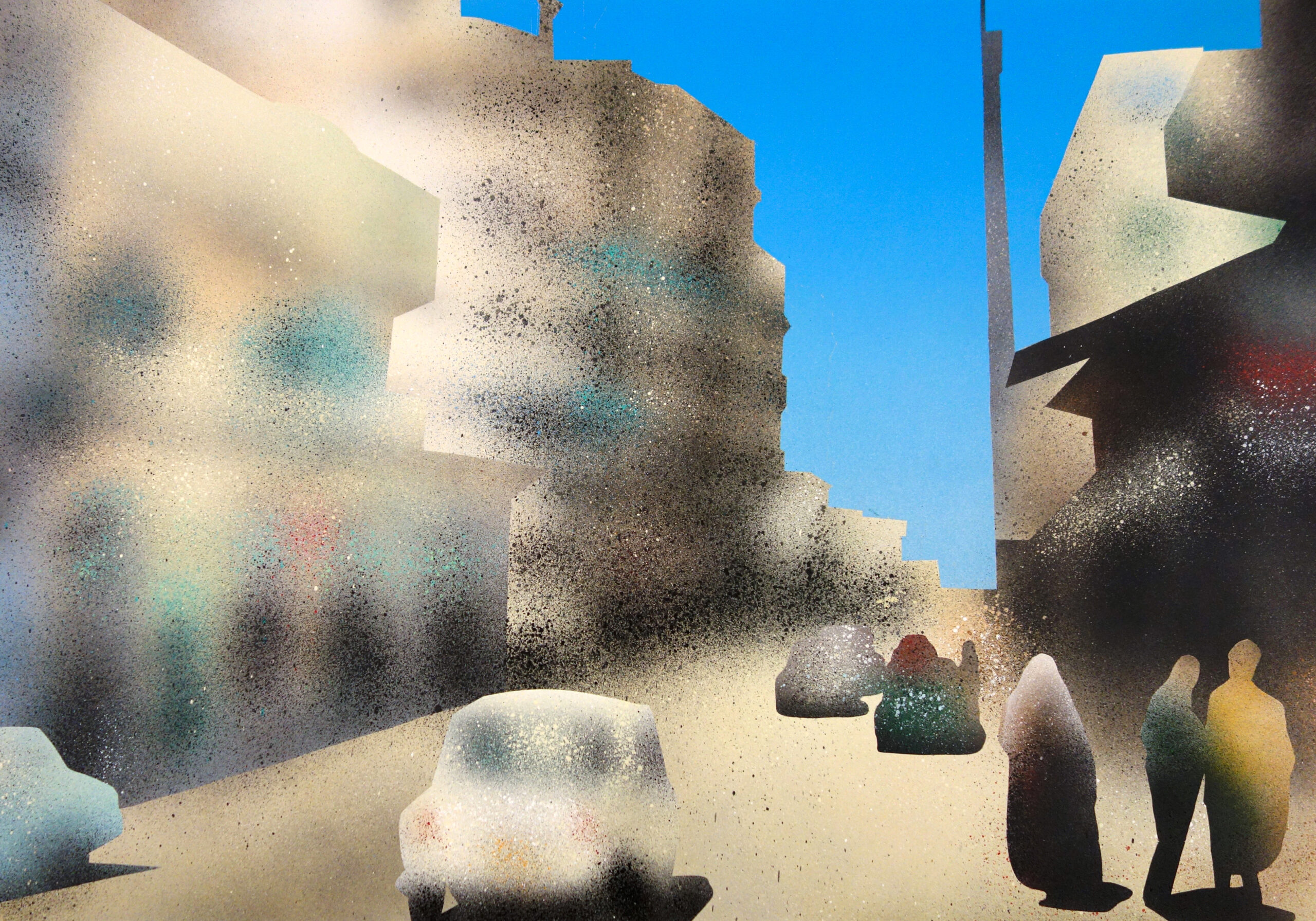
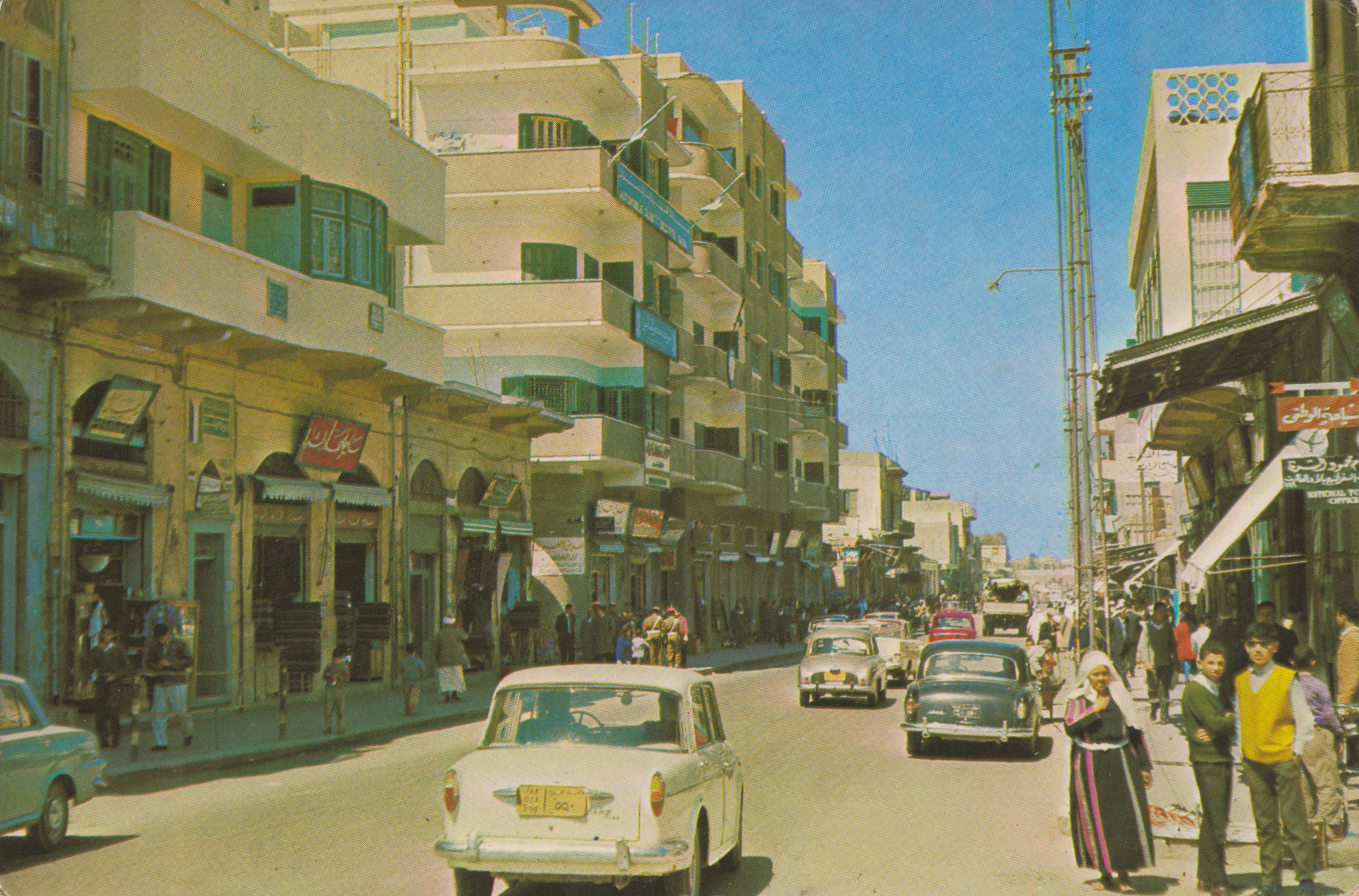
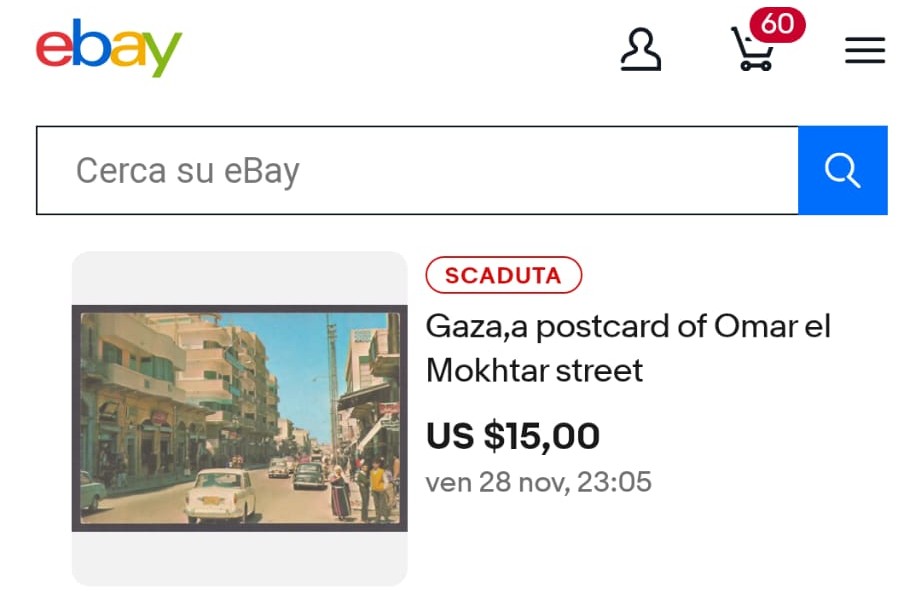
It emerges as a natural extension of Postcard Lottery, but it shifts its meaning. Normally, a postcard is tied to a positive memory — a trip, a place to share. Here, the opposite happens. The image shows Gaza City in the 1970s, a lively, everyday city. But seen today, that same image becomes something entirely different.
What interested me was precisely this gap: using a familiar object to create a disruption. Receiving a postcard that, instead of pointing to a visitable place, confronts you with something that no longer exists in the same way. In this case, Gaza becomes almost a non-place: somewhere that exists in memory and images, but that today is no longer recognizable as such.
This direction also emerged in dialogue with Enrico (executive personal assistant to Woc): while working on the project, we realized that the very act of sending an image could become a form of storytelling, almost a presence arriving at your home without the need for explanation.
What happens when a postcard stops depicting a “happy” place?
It completely breaks its code. A postcard is usually tied to something positive. If I send you a postcard from my hometown or from a city I’m visiting, it’s because I want to share something beautiful. In the case of Gaza, however, behind that image there is today destruction, pain, absence.
This is exactly what creates the disruption. It becomes a silent form of denunciation: there is no speech, no explanation. Just an image being sent. And that is precisely what makes it powerful. It is a silent scream that, if truly listened to, almost makes you want to cover your ears.
So does the project have a political dimension?
WOC: Not really, or rather: it stops before that. It is not conceived as a political project, nor does it aim to take an explicit stance. The focus is on human rights. A city has been destroyed. That is the starting point.
Before any position or interpretation, there is a human fact. And for us, the project sits there: in that space that comes before politics. We do not want to tell people what to think, but to confront them with something that forces them to pause. To question.
How important is the theme of memory in this work?
It is central. A postcard is an object that can reappear over time. It can sit in a drawer for years and then reappear. At that moment it becomes a question: what place was this?
The project works exactly on this. It is an act of memory, but also a way of leaving traces over time. If in ten years someone finds that postcard, or a child asks what it represents, something is activated. And that alone is meaningful.
Is the project also rooted in a reflection on nostalgia?
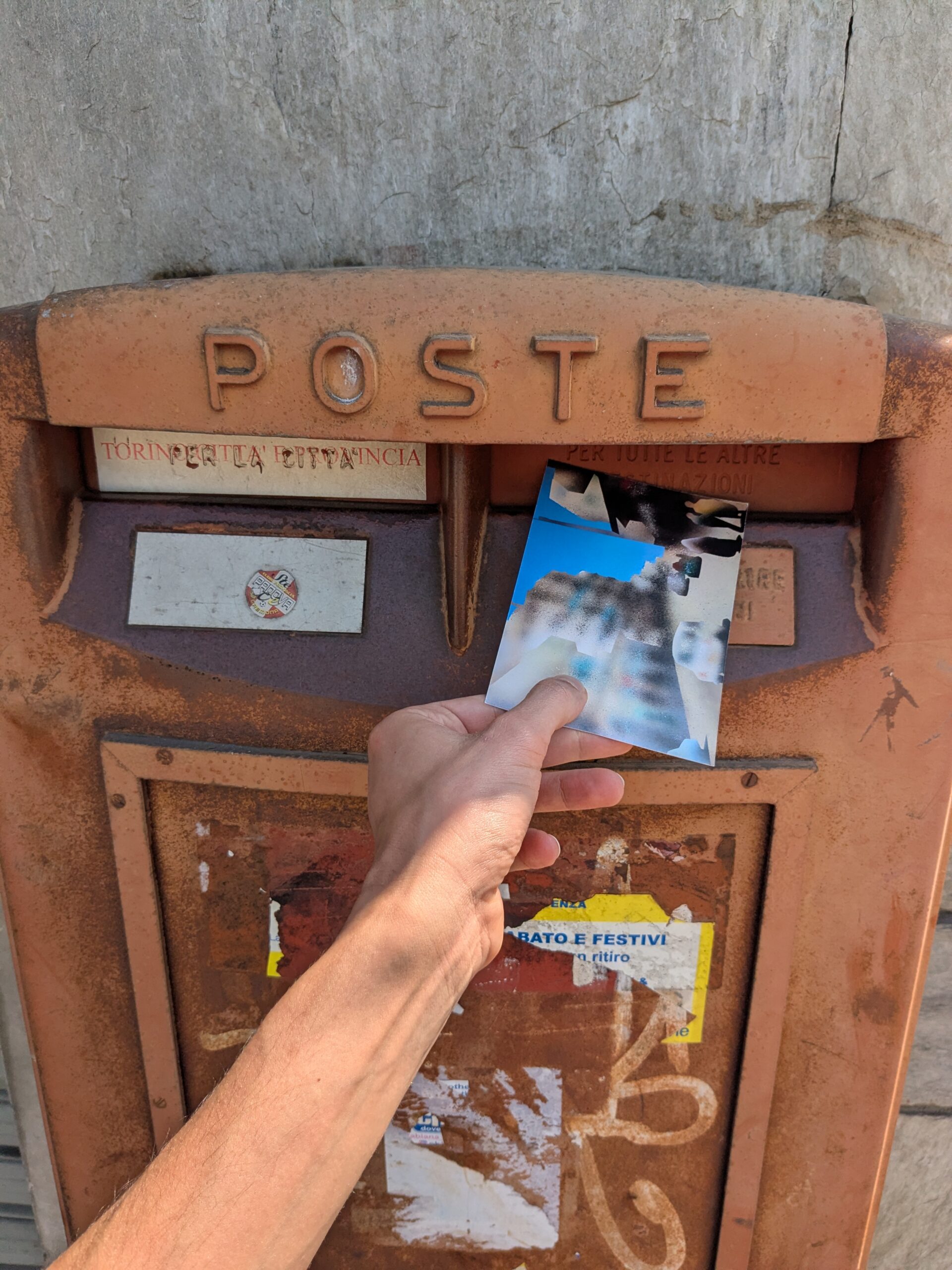
Yes, absolutely. The very act of sending a postcard today is almost gone. When we started the project, I looked for postboxes near my studio — there weren’t any anymore. This gesture, once everyday, has now become rare. Walking to post a postcard, entrusting an image to a slow, uncertain journey — these are all things we have lost.
Here, instead, they become central again: how do I send a memory today? How long does it take to arrive? What value does it have? Even the risk of it getting lost, of arriving months later — all of this is part of the process.
Let’s talk about the image: how did you choose the Gaza postcard?
It was a complex process. We found very few postcards. Gaza was never a tourist destination in the traditional sense, and many images were difficult to source or contextualize. The one we chose is among the most “bright,” closest to the traditional idea of a postcard: a street in Gaza City in the 1970s. The selection was also guided by precise visual criteria: the image had to work both aesthetically and after being filtered through my painting process.
What do people actually receive when they support the project?
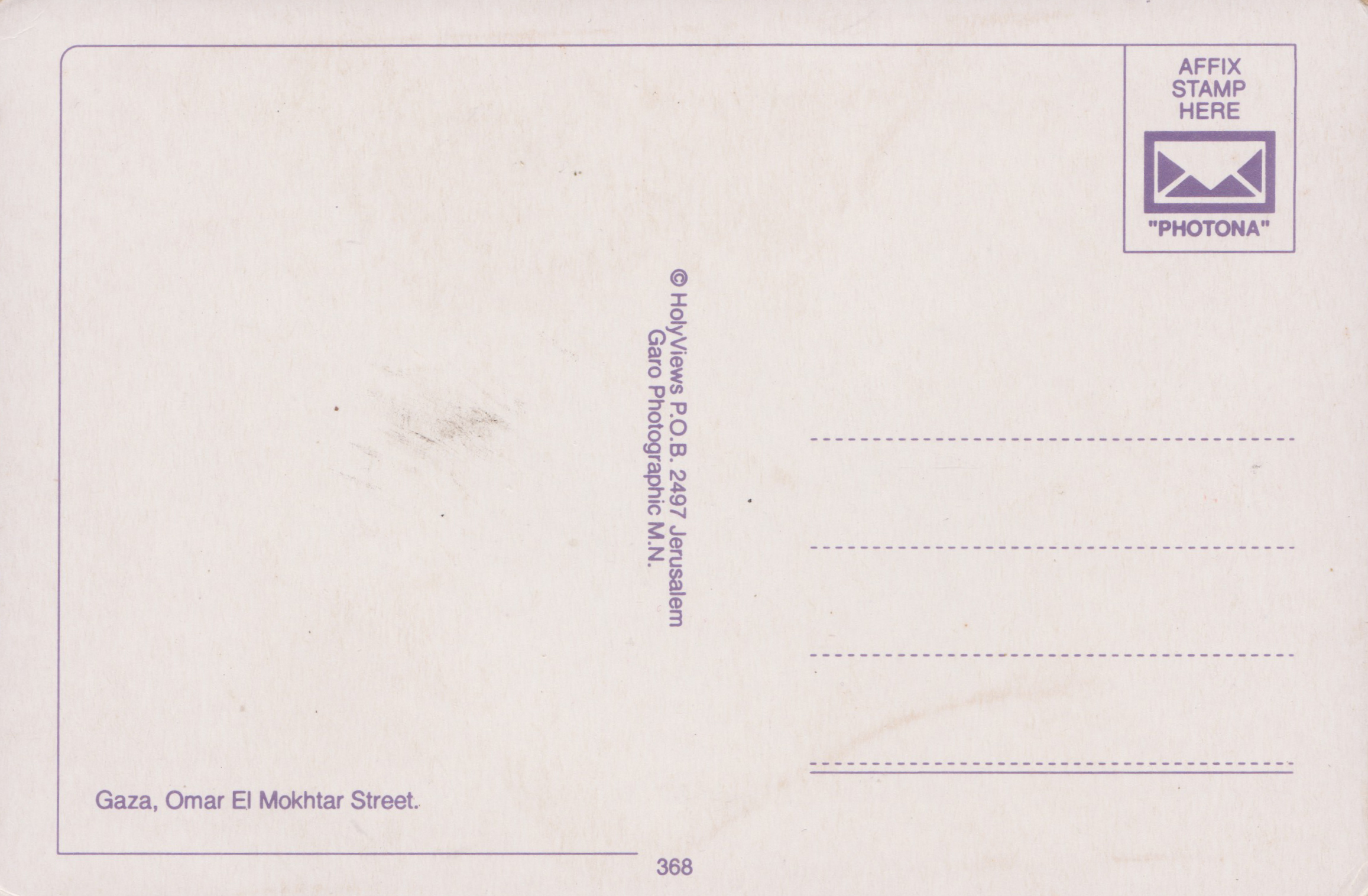
Those who visit the website find a postcard. On the front is this image of Gaza. On the back, there is a handwritten message: “Greetings from Gaza,” accompanied by a short claim and logos. It is a deliberately simple, almost standard format. And it is precisely this normality that makes it powerful.
Why did you choose to collaborate with Amnesty International Italia, and how will the funds be used?
WOC: It was essential to have a transparent and credible partner. We absolutely did not want the project to be perceived as a way of profiting from tragedy.
Enrico: We evaluated several actors, but Amnesty immediately felt like the most coherent choice: it is a global, active, and widely recognized organization. Getting in touch with them was not easy, but when it happened, we found a very rigorous, almost radical approach, which convinced us even more. The funds collected will be managed by Amnesty and distributed according to urgency: part of them will also be allocated to Gaza, but not exclusively. For us this is important, because it reinforces the idea that the project is not tied only to one place, but to a broader reflection on human rights.
Regarding the project, Laura Petruccioli — Amnesty International Italia representative — notes:
“We have asked ourselves many times whether, and how, art can help human rights. For us it does, and upon reflection, it always has: it may not have the power to change things directly, but it tells stories and prompts reflection. And this matters, with a genocide ongoing: multiplying the voices that remember it is fundamental, especially when there is a strong push to speak of it in the ‘past tense,’ as if everything were already over.
The Postcard Lottery for Charity — Greetings from Gaza project also succeeds in combining artistic expression and action for the protection of human rights, transforming cultural participation into a concrete gesture of support.”
Can this project evolve in the future?
Yes, it is designed to be versatile. Gaza is the first case, but the mechanism can be applied to other places, other situations. The idea is always the same: using an image to question the present.
Did you have specific artistic references for this work?
Honestly, no, not directly. Of course I am aware of artistic practices linked to social or humanitarian themes, but in this case there was no specific reference.
Rather than individual artists, I feel connected to a broader visual imaginary, especially practices that use public space and images as communication tools.
Can we also read this project as a new form of street art?
In a sense, yes. It is a form of street art that has shifted into the digital space. It does not intervene directly in physical space, but works through the circulation of images.
It is a project that speaks about something real, but does so through contemporary channels. And this completely changes the way the message circulates.
At the end of this interview, one question emerges: what can an image still do today, in the face of destruction? The most honest answer is:
probably not much. But that is not the point.
Greetings from Gaza, Woc’s new project, starts exactly here. It reclaims the postcard — one of the most innocent objects that exist — and pushes it into a short circuit, transforming it from a memory of a city into a trace of a place erased from maps, no longer visitable.
In this sense, Woc’s postcard addresses the same problem as Guernica. It does not try to explain war, but, as Georges Didi-Huberman suggests, exposes its remains: fragments of a past that can no longer be reassembled.
Writers and street artists have always worked like this. Rather than adding new images to the world, they shift existing ones just enough to produce a sense of estrangement that catches the attention of passersby. This is what Banksy also did in Palestine. His interventions, first with Santa’s Ghetto and later especially with the Walled Off Hotel, function as visual traps: they invite you to look — to click, to like — without ever clarifying how. Denunciation? Irony? Tourism? Or all at once? And this is where things become complicated. Because, at the very moment an image makes something visible, it also risks domesticating it — turning it into experience, into content formatted for social media.
Perhaps this is the limit — and at the same time the only possibility. Not to change what is happening, but to fracture, even just with a postcard, the way we are used to seeing it.
A memory in memory of a place that no longer exists